The essential property of ownership that I'm concerned with here is exposure to the upside of the productive potential of something. It's the key motivator that makes people want to make things better. Making things better is often very difficult. So in order to motivate someone to do the difficult things, they need to have exposure to the upside that it creates. I'm not aware of any other motivating factor as powerful. Other than perhaps fear. During World War II, many industrialists were highly motivated to manufacture war material. In fact, it often burned them out in a way that their operations prior to the war didn't. But fear is like a force of nature. It's hard to harness on demand.
So what motivates the people that manage our cities, states and nations? In wartime it's fear. But in peacetime, they are motivated only to keep their jobs. Not to maximise the value of the assets under management. So how do we bring ownership to governance?
My solution is to create asset classes in the following hierarchy nation > state > region > city > district > neighbourhood > building > dwelling. The exact taxonomy and number of levels isn't super important. There's definitely an optimal number but I don't know what that number is and I'm pretty sure my idea will work with a sub-optimal taxonomy. The important thing is that each level exists, that siblings can be added or removed at any level by the parent, and that each level leases its components rather than selling them outright. I'll call whoever holds the lease on something its operator. The operators one level down are its tenants and the one above is its parent.
This is really the part that most people will find surprising. Especially since I'm advocating for the merit of ownership here. But to understand why leasing is the right way to go you need to understand that the children of a node in this hierarchy constitute shares in that parent. And selling them would be like selling the shares of a company. Sell a few. Yeah, sure, you can do that. But sell them all and then you no longer have any incentive to increase their value. Say a region builds a road between two of its cities. Both cities become worth more. If the region leases the cities then their rent rises and the road pays for itself. If the region had sold them then the buyers pocket the gain and the region has no reason to build the next road.
The owners of the child nodes could theoretically band together and make decisions to improve their collective value, but when has that ever worked? A council or a body corporate is what you get when they try. It hires a manager on a salary and we're back where we started. Decisions need to be made by one person. A group can only act on what all of its members understand, which is the intersection of what each of them knows. And the intersection of sets is never larger than the smallest set being intersected, and is usually smaller. Hence, you're better off to let the dumbest person make the decision than to make the decision as a group.
None of this is new at small scale. The owner of a shopping centre leases the shops and pays for the car park, the security and the advertising, because a busier centre means higher rents. The Grosvenor family has leased out Mayfair in London for three hundred years and it's still one of the most expensive parts of the city. Hong Kong's rail company pays for new lines out of the profit on land around its stations. The hierarchy also resembles feudalism, with its crown, lords and tenants. But feudal lords were selected for their strength. Here a lease goes to whoever will pay the most for it. Which might raise the concern that this could devolve into feudalism. However, military strength is derived much more from economic strength these days than it was back then. So the best businessman is de facto the best warlord now.
It's a pretty simple solution but let's run through an example. The devil usually is in the details.
Let's imagine that Mars is about to be colonised. The first person to land there claims ownership of the planet. Let's call them the crown. The crown leases out chunks of it to anyone that wants to operate a state. It takes expressions of interest and carves the planet into half as many pieces as there are interested parties and auctions them off. Some miss out but that was intentional. The process recurses until each state has been allocated down to the neighbourhood level. Then the building begins. At first everything will be leased at a very low price but the most successful operators will bid up the price their siblings pay and drive them out of business. The crown can create a new state whenever leases come up, just by dividing the parcels further. If no new bidders enter then the old states will just operate multiple legal states as one until a new bidder outbids them. The same thing happens at every level of the hierarchy. If some level has very few bidders then operating at that level will be highly profitable, and the profit will drive talent in that direction.
The upside
An operator's upside is whatever the difference is between them and the second highest bidder. Their rent is set by what the next guy would pay, so their profit is proportional to how much better they are than the next guy. Any business with competitors runs on this motive.
But if a rival can bid at any time, an operator who makes a city better will watch their rent rise to match, and their parent collects the gain. A shop that makes its street popular gets the same treatment from its landlord. So the terms of a lease matter, and it's up to each tenant to negotiate them. I imagine a popular solution will be to look at the growth rate of the rent and lock that rate in for the next 10 years. Rivals can't bid until the 10 years are up. The tenant keeps any additional growth that they generate in that time. And it will presumably be due to the tenant, because otherwise the parent wouldn't have been willing to lock in at the current rate.
A 10 year term has a weak spot near its end. In year nine, an improvement that takes five years to pay off isn't worth making. I expect tenants and parents will negotiate the next term a few years before the current one runs out.
So when a city gets better, its districts become worth more, and bidders offer more for each district as its lease comes up. The city's own rent is locked, so it keeps the gain until its term ends. That's exposure to the upside. It's the thing a mayor on a salary doesn't have.
Squeezing the tenants
An operator could also raise their profit by overcharging the tenants below them. Their parent has reason to stop this. A city that squeezes its districts ends up with fewer and poorer districts. It can then afford less rent for its own lease, and the region above collects less. So each parent wants its children to compete hard and to treat their own tenants well. The tenants can also leave. If you don't like your building you can move to another one in the same district. Moving is cheap at the bottom of the hierarchy and gets more expensive towards the top.
Transferring improvements
When a lease changes hands the old operator needs to get a fair price for their improvements. In the case of states this will be the inter-region roads and power lines. Each operator declares what an improvement is worth when they build it. The new operator can pay the declared price, or they can front the cost of having the improvements valued by a 3rd party chosen by the crown. If the result is lower than the declared price then the old operator must reimburse the new operator for the cost of the valuation, and the improvements change hands at the valued price. Otherwise the challenger pays for the valuation and the lease transfer will be cancelled unless they decide to pay the newly assessed value.
An operator who declares too high will end up paying for valuations. One who declares too low can lose their work for less than it's worth. And frivolous lease acquisition attempts will be rare because they leave the tyre kicker with the assessment bill. I've written a fuller version of these rules for a single plot of land in allocating land.
In some cases the 3rd party will be corrupted but the crown has an incentive to prevent this from happening because the value of their leases depends on the confidence of the states in the crown's ability to resolve these kinds of issues. That's not to say that corruption will never happen. But at least there are strong incentives against it. This same process of lease transfer will work at all levels of the hierarchy. Any node in the hierarchy that fails to resolve lease transfer issues will cease to be a desirable place for genuine operators and will lose value.
A state that won't leave
A state that gets outbid might refuse to hand over its lease. The crown can ask its other states to evict it. They will be happy to do this because if the crown fails then they lose the services the crown provides to them, such as settling their disputes with each other. If the crown provides no such services then the states won't come to its aid, and it deserves to fail. If this happens the states have two options. A) Extract what value they can from their tenants and rebuild under another crown somewhere else. Or B) replace the crown. Replacing the crown is likely to be a messy process and will likely fail but it’s worth a try since they can always revert to option A. If the same problem occurs at a lower level in the hierarchy it's easier to resolve since the parent can simply find another tenant.
This only works while the holdout is outnumbered. An operator that holds half the states can't be evicted by the other half. So a crown that wants to survive won't let one operator hold too many of them.
The top of the hierarchy
That leaves the crown. Every other operator has a parent that can replace them and siblings that compete with them. The crown has neither, and nobody can outbid it. The solution in the case of Mars is to create several crowns and rely on balance of power dynamics to prevent consolidation.
I’d slice the planet vertically pole to pole into 12 crowns. Each will get roughly equal resources this way. Slice 1 and 12 are clearly worse than the others but what can you do.
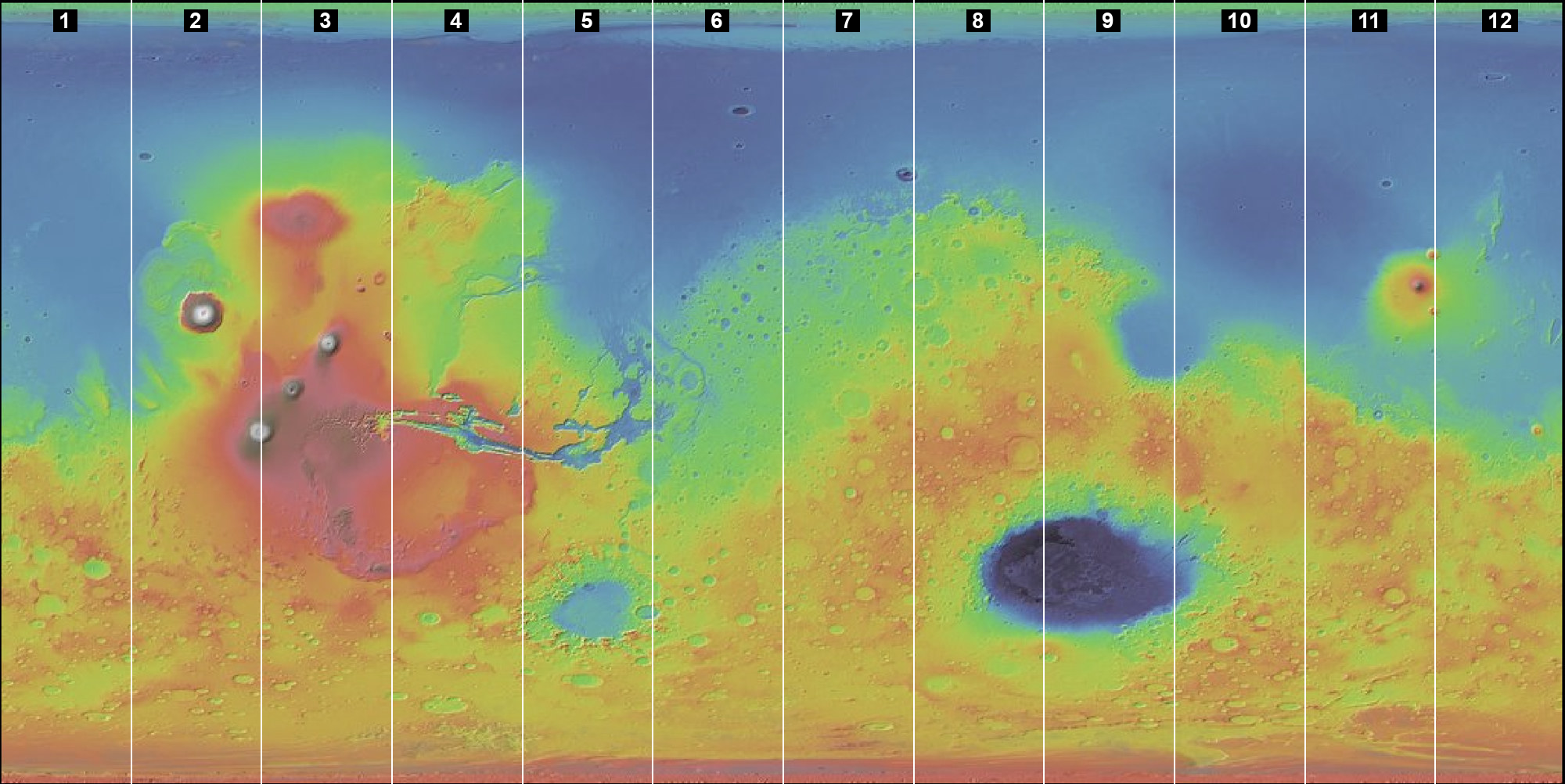
The downside of having 12 crowns is that planet scale projects become harder to coordinate. And on Mars there will be some very expensive planet scale projects. Such as warming the planet up and giving it a breathable atmosphere. You might think the nobleness of the goal would motivate them to work together but in the early years they will be strongly incentivised to make their slice the most attractive to settlers and so will want to dump all their resources into their own slice rather than planet wide terraforming.
Nevertheless, I think that the balance of powers approach is better in the long term than the single crown approach. They won't be resource constrained for a long time. And by the time they are the tradition of cooperation should be well established. At that point I think it's likely that some crowns will become rent seekers. They will lease their slice to the more efficiently run crowns and simply live off the royalties. This will rub the other crowns the wrong way and eventually lead to a breakdown of the system. And once the tradition is broken the end result will be war and a single crown coming out on top. Like the Roman Empire. But the Roman Empire would have never become the Roman Empire had it not had the balance of powers phase. So while a single crown is inevitable, I still think it's better to start with 12.
At this point we have a succession problem and I don't have a solution.